POWER AND CONFLICT
Remains
A shooting that seems finished remains mentally present because responsibility and uncertainty have not ended.
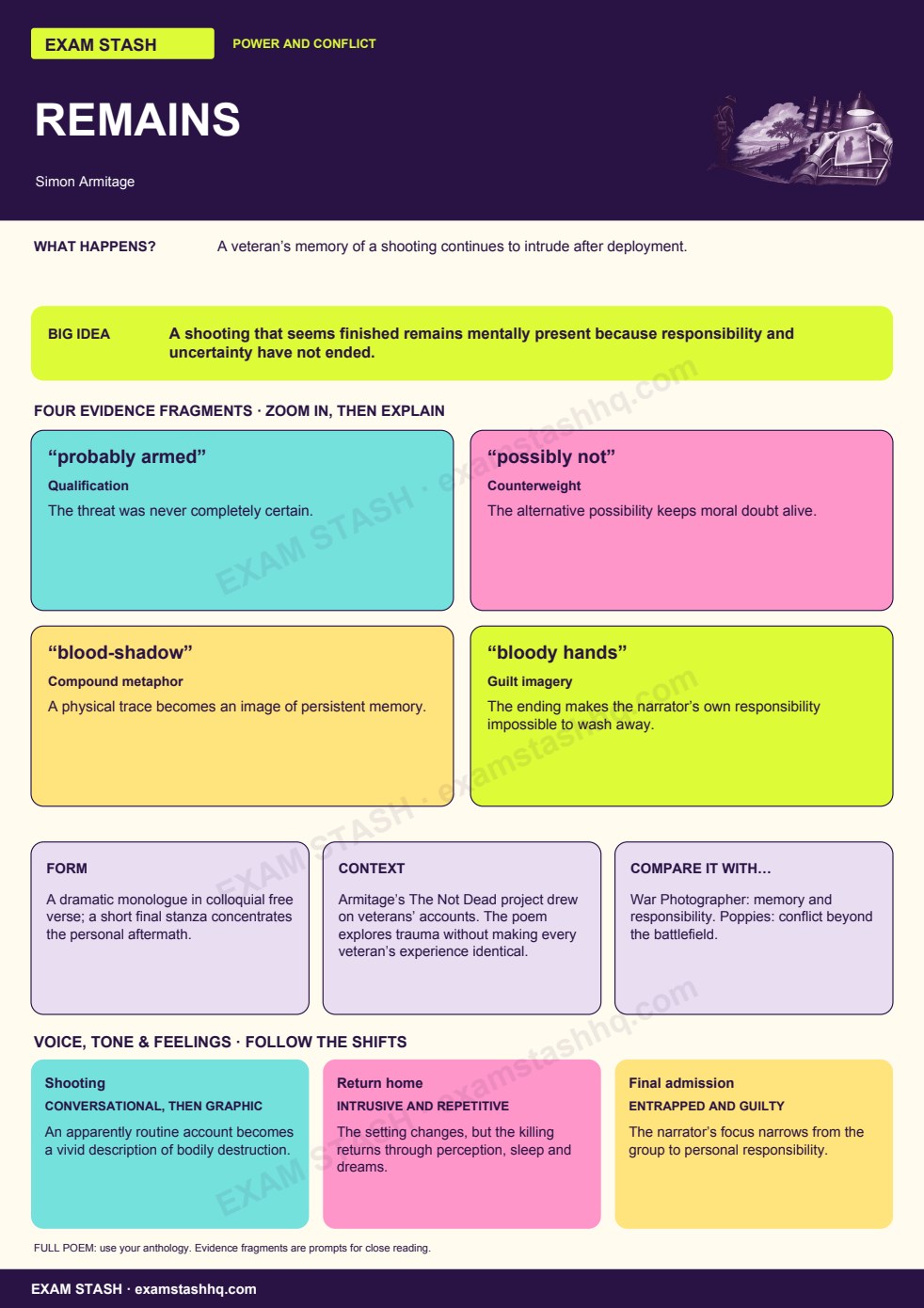
Read the accessible text and study notes
What happens?
A veteran’s memory of a shooting continues to intrude after deployment.
Big idea
A shooting that seems finished remains mentally present because responsibility and uncertainty have not ended.
“probably armed”
Qualification — The threat was never completely certain.
“possibly not”
Counterweight — The alternative possibility keeps moral doubt alive.
“blood-shadow”
Compound metaphor — A physical trace becomes an image of persistent memory.
“bloody hands”
Guilt imagery — The ending makes the narrator’s own responsibility impossible to wash away.
Form
A dramatic monologue in colloquial free verse; a short final stanza concentrates the personal aftermath.
Context
Armitage’s The Not Dead project drew on veterans’ accounts. The poem explores trauma without making every veteran’s experience identical.
Compare
War Photographer: memory and responsibility. Poppies: conflict beyond the battlefield.
Voice, tone and feelings
Shooting · Conversational, then graphic — An apparently routine account becomes a vivid description of bodily destruction.
Return home · Intrusive and repetitive — The setting changes, but the killing returns through perception, sleep and dreams.
Final admission · Entrapped and guilty — The narrator’s focus narrows from the group to personal responsibility.
Recall
How does the meaning of returning home become complicated?
Read the full poem in your own AQA anthology. Anthology information and source.