LOVE AND RELATIONSHIPS
Porphyria’s Lover
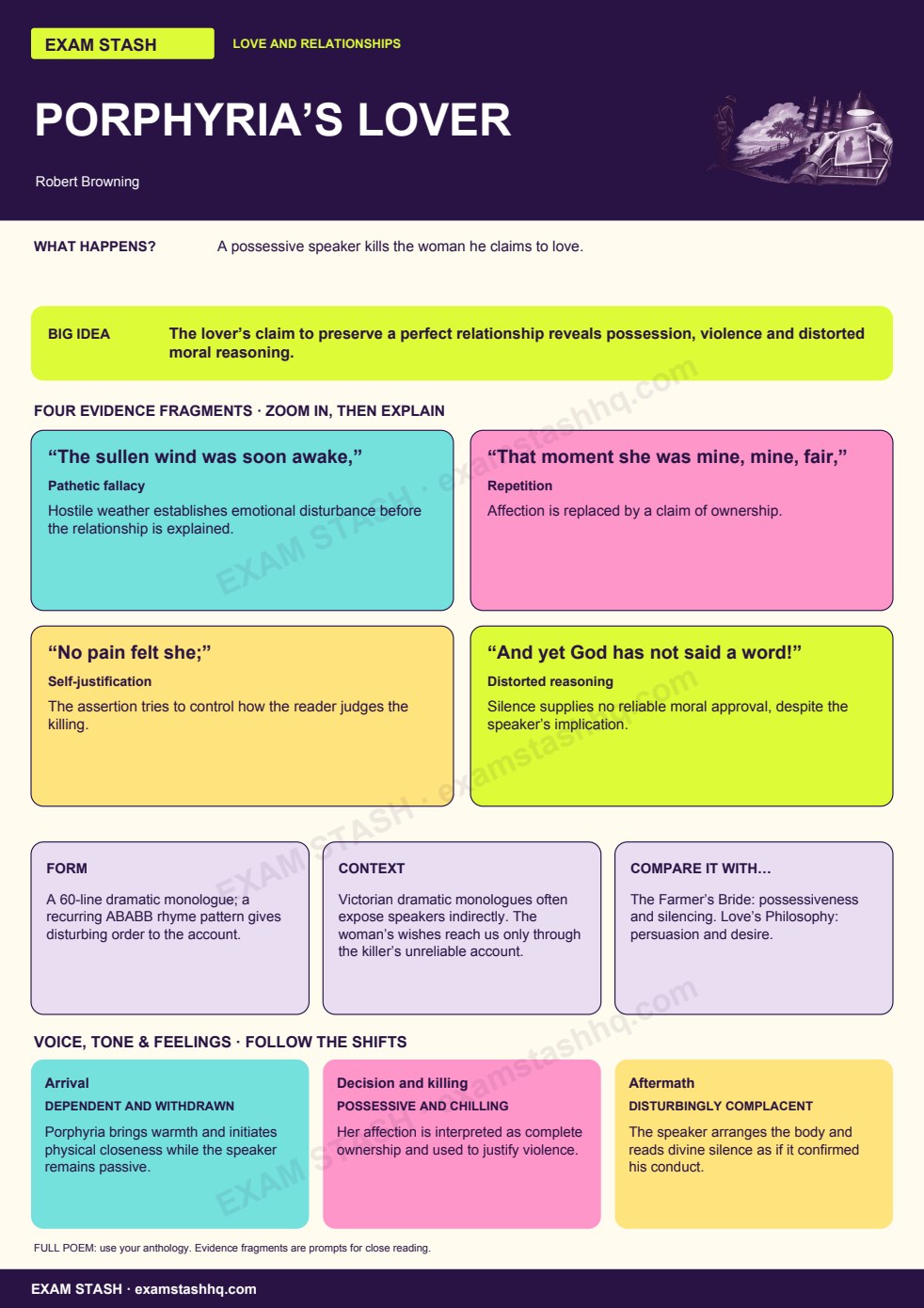
The lover’s claim to preserve a perfect relationship reveals possession, violence and distorted moral reasoning.
Read the accessible text and study notes
What happens?
A possessive speaker kills the woman he claims to love.
Big idea
The lover’s claim to preserve a perfect relationship reveals possession, violence and distorted moral reasoning.
“The sullen wind was soon awake,”
Pathetic fallacy — Hostile weather establishes emotional disturbance before the relationship is explained.
“That moment she was mine, mine, fair,”
Repetition — Affection is replaced by a claim of ownership.
“No pain felt she;”
Self-justification — The assertion tries to control how the reader judges the killing.
“And yet God has not said a word!”
Distorted reasoning — Silence supplies no reliable moral approval, despite the speaker’s implication.
Form
A 60-line dramatic monologue; a recurring ABABB rhyme pattern gives disturbing order to the account.
Context
Victorian dramatic monologues often expose speakers indirectly. The woman’s wishes reach us only through the killer’s unreliable account.
Compare
The Farmer’s Bride: possessiveness and silencing. Love’s Philosophy: persuasion and desire.
Voice, tone and feelings
Arrival · Dependent and withdrawn — Porphyria brings warmth and initiates physical closeness while the speaker remains passive.
Decision and killing · Possessive and chilling — Her affection is interpreted as complete ownership and used to justify violence.
Aftermath · Disturbingly complacent — The speaker arranges the body and reads divine silence as if it confirmed his conduct.
Recall
Why must we question the speaker’s account of the woman’s wishes?
Read the full poem in your own AQA anthology. Anthology information and source.