LOVE AND RELATIONSHIPS
Neutral Tones
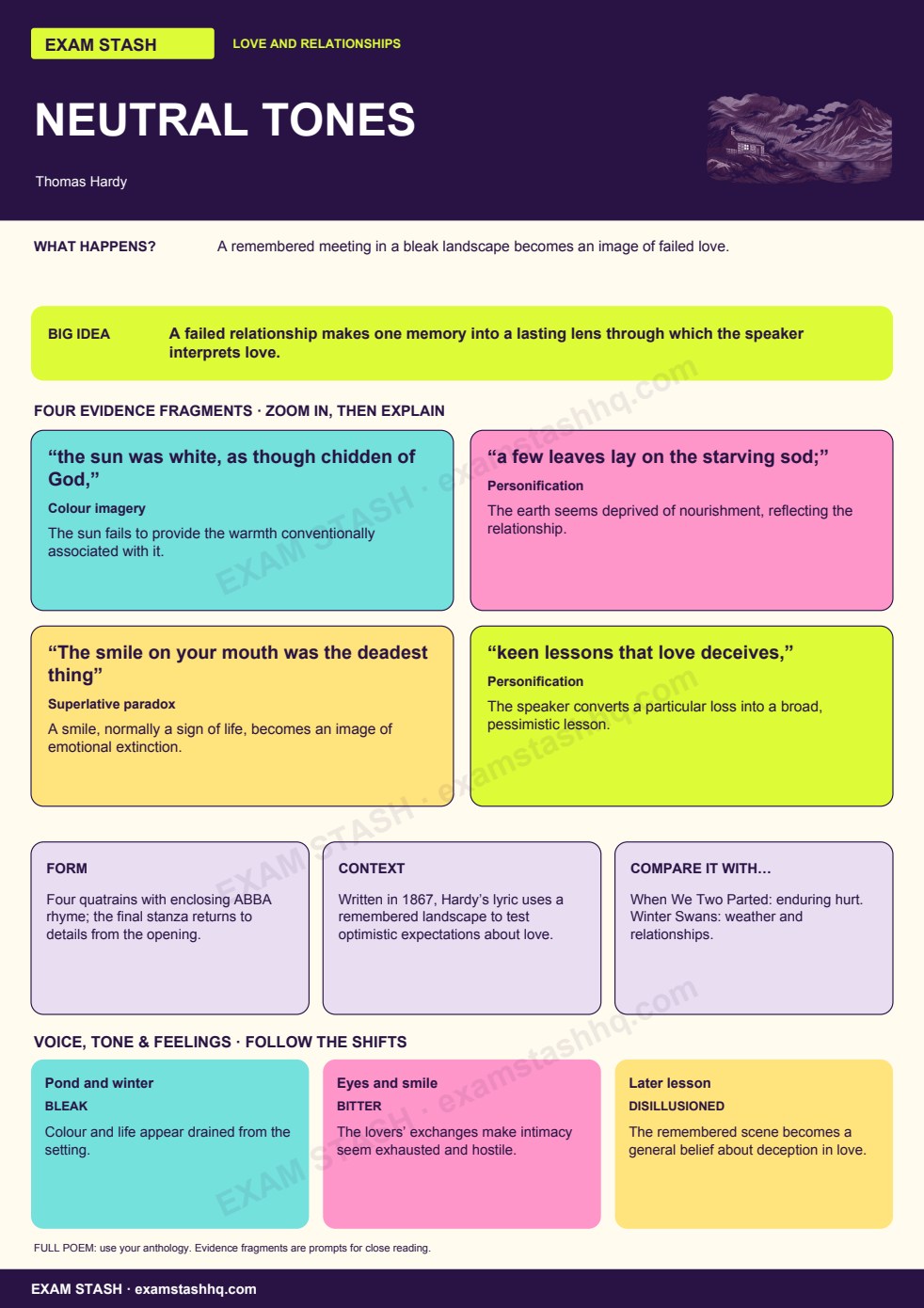
A failed relationship makes one memory into a lasting lens through which the speaker interprets love.
Read the accessible text and study notes
What happens?
A remembered meeting in a bleak landscape becomes an image of failed love.
Big idea
A failed relationship makes one memory into a lasting lens through which the speaker interprets love.
“the sun was white, as though chidden of God,”
Colour imagery — The sun fails to provide the warmth conventionally associated with it.
“a few leaves lay on the starving sod;”
Personification — The earth seems deprived of nourishment, reflecting the relationship.
“The smile on your mouth was the deadest thing”
Superlative paradox — A smile, normally a sign of life, becomes an image of emotional extinction.
“keen lessons that love deceives,”
Personification — The speaker converts a particular loss into a broad, pessimistic lesson.
Form
Four quatrains with enclosing ABBA rhyme; the final stanza returns to details from the opening.
Context
Written in 1867, Hardy’s lyric uses a remembered landscape to test optimistic expectations about love.
Compare
When We Two Parted: enduring hurt. Winter Swans: weather and relationships.
Voice, tone and feelings
Pond and winter · Bleak — Colour and life appear drained from the setting.
Eyes and smile · Bitter — The lovers’ exchanges make intimacy seem exhausted and hostile.
Later lesson · Disillusioned — The remembered scene becomes a general belief about deception in love.
Recall
How does the landscape become part of the memory?
Read the full poem in your own AQA anthology. Anthology information and source.