LOVE AND RELATIONSHIPS
Love’s Philosophy
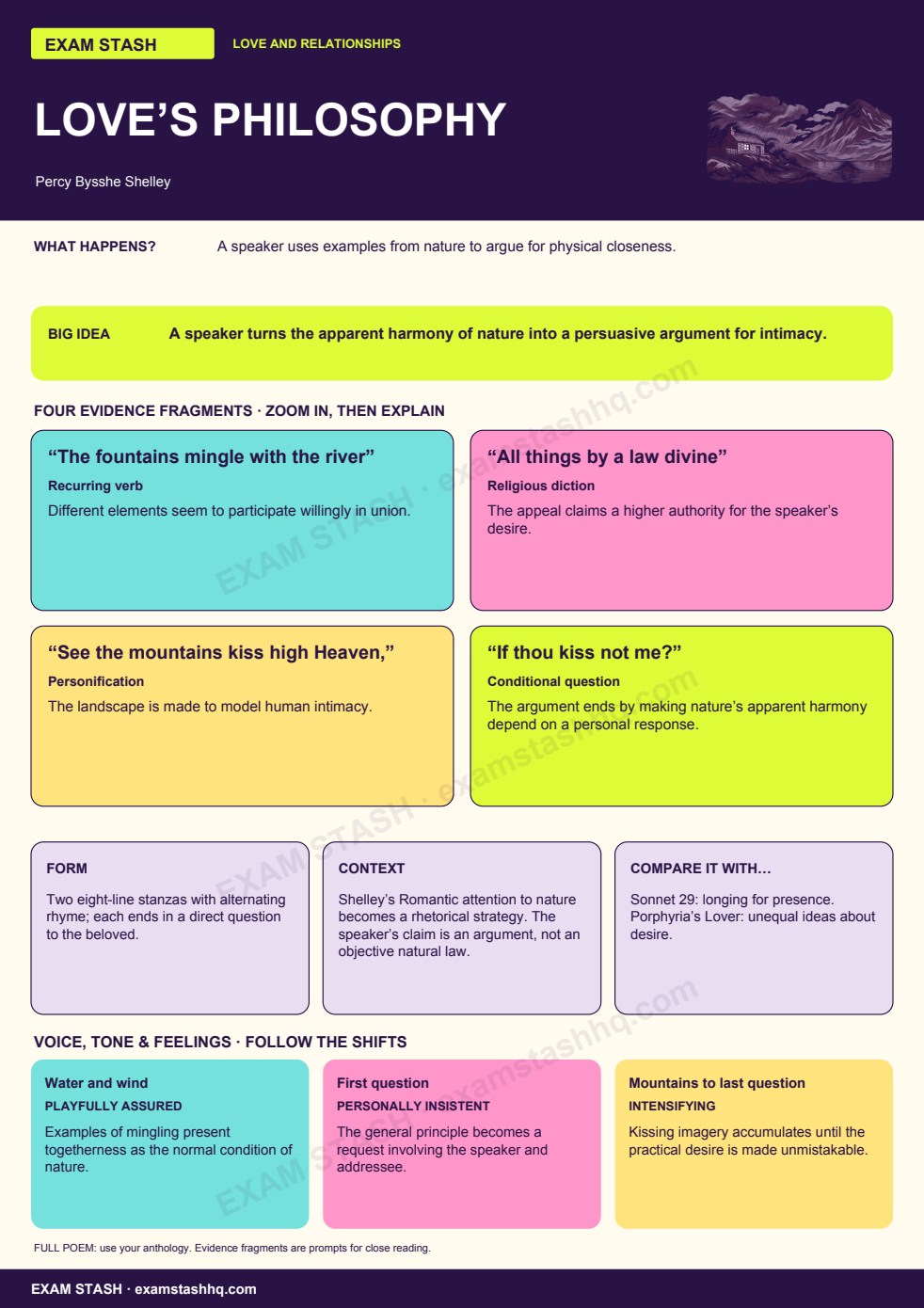
A speaker turns the apparent harmony of nature into a persuasive argument for intimacy.
Read the accessible text and study notes
What happens?
A speaker uses examples from nature to argue for physical closeness.
Big idea
A speaker turns the apparent harmony of nature into a persuasive argument for intimacy.
“The fountains mingle with the river”
Recurring verb — Different elements seem to participate willingly in union.
“All things by a law divine”
Religious diction — The appeal claims a higher authority for the speaker’s desire.
“See the mountains kiss high Heaven,”
Personification — The landscape is made to model human intimacy.
“If thou kiss not me?”
Conditional question — The argument ends by making nature’s apparent harmony depend on a personal response.
Form
Two eight-line stanzas with alternating rhyme; each ends in a direct question to the beloved.
Context
Shelley’s Romantic attention to nature becomes a rhetorical strategy. The speaker’s claim is an argument, not an objective natural law.
Compare
Sonnet 29: longing for presence. Porphyria’s Lover: unequal ideas about desire.
Voice, tone and feelings
Water and wind · Playfully assured — Examples of mingling present togetherness as the normal condition of nature.
First question · Personally insistent — The general principle becomes a request involving the speaker and addressee.
Mountains to last question · Intensifying — Kissing imagery accumulates until the practical desire is made unmistakable.
Recall
Is the speaker’s argument persuasive, playful or pressuring?
Read the full poem in your own AQA anthology. Anthology information and source.