POWER AND CONFLICT
London
Oppression is a system shaping bodies, voices and even the ways people imagine freedom.
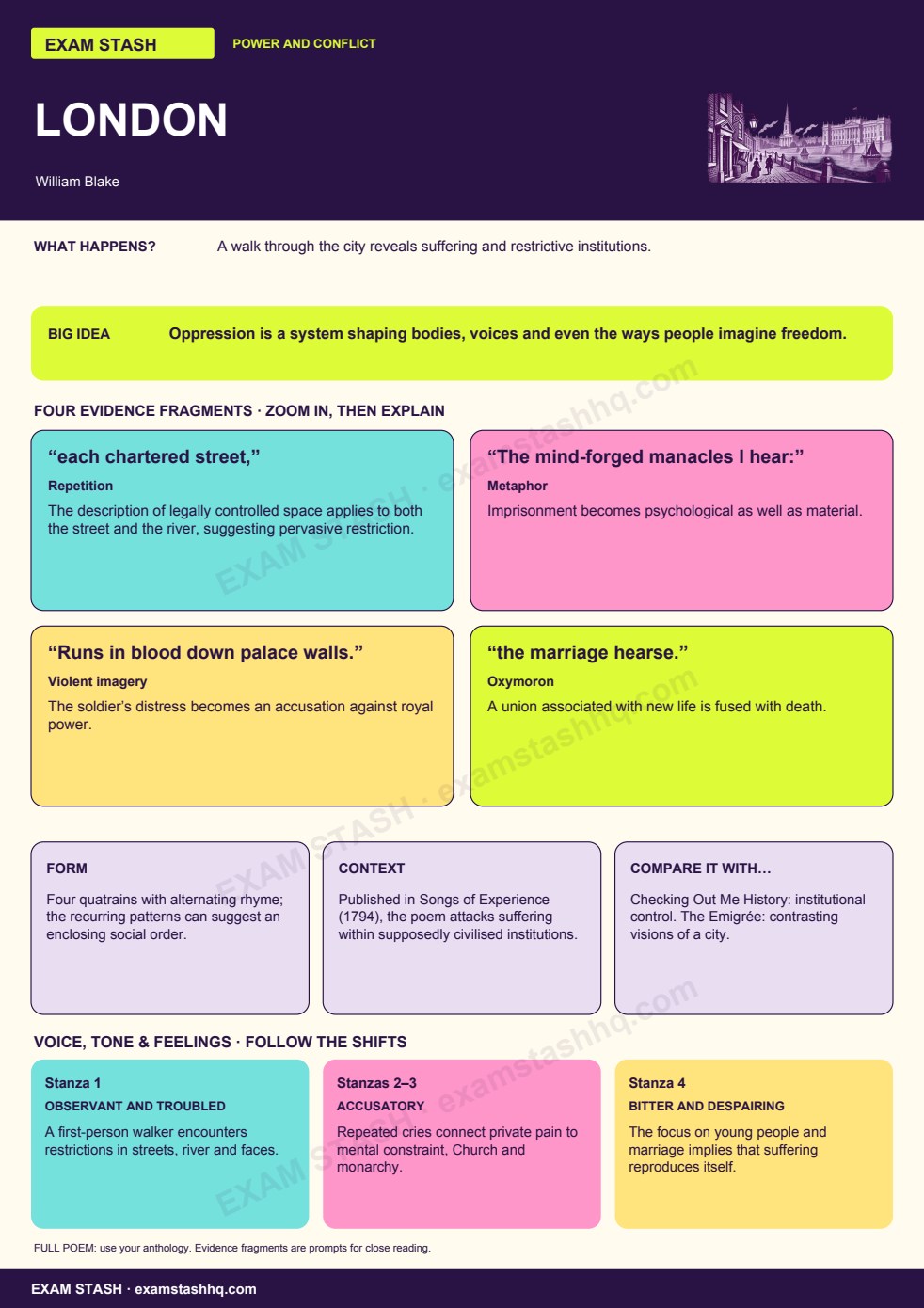
Read the accessible text and study notes
What happens?
A walk through the city reveals suffering and restrictive institutions.
Big idea
Oppression is a system shaping bodies, voices and even the ways people imagine freedom.
“each chartered street,”
Repetition — The description of legally controlled space applies to both the street and the river, suggesting pervasive restriction.
“The mind-forged manacles I hear:”
Metaphor — Imprisonment becomes psychological as well as material.
“Runs in blood down palace walls.”
Violent imagery — The soldier’s distress becomes an accusation against royal power.
“the marriage hearse.”
Oxymoron — A union associated with new life is fused with death.
Form
Four quatrains with alternating rhyme; the recurring patterns can suggest an enclosing social order.
Context
Published in Songs of Experience (1794), the poem attacks suffering within supposedly civilised institutions.
Compare
Checking Out Me History: institutional control. The Emigrée: contrasting visions of a city.
Voice, tone and feelings
Stanza 1 · Observant and troubled — A first-person walker encounters restrictions in streets, river and faces.
Stanzas 2–3 · Accusatory — Repeated cries connect private pain to mental constraint, Church and monarchy.
Stanza 4 · Bitter and despairing — The focus on young people and marriage implies that suffering reproduces itself.
Recall
How does the speaker connect individual distress to systems?
Read the full poem in your own AQA anthology. Anthology information and source.