COMPARISON
Storm on the Island / Extract from The Prelude
Power of nature — landscape comparison.
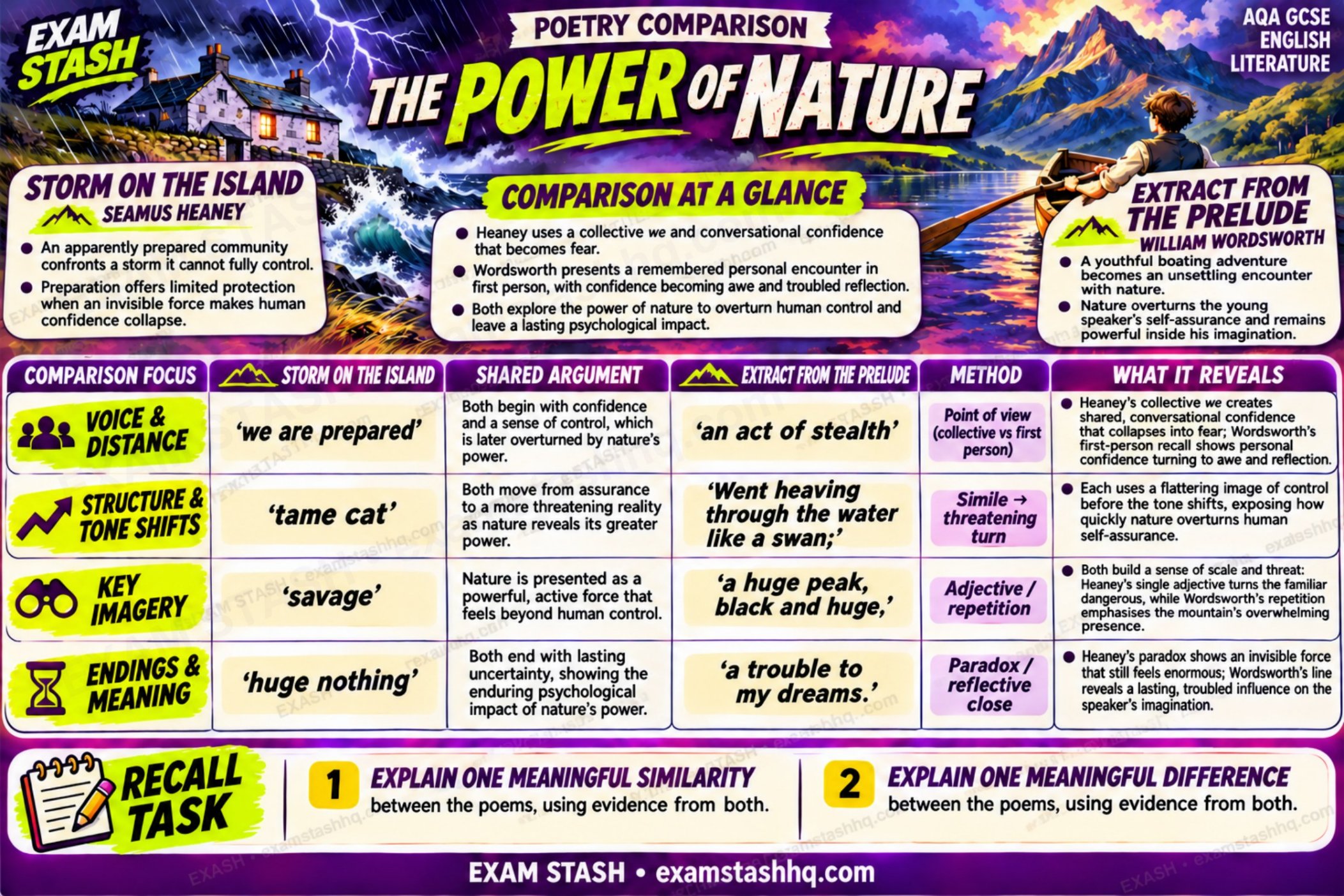
Read the comparison notes
Heaney’s collective voice begins with practical confidence before fear unsettles it. Wordsworth recalls a personal experience in which confidence gives way to awe and a lasting disturbance. Compare the invisible storm with the apparently pursuing peak, and explain how each challenges human control.
Storm on the Island
One 19-line stanza, predominantly blank verse; conversational address gives way to military imagery.
prepared
Declarative opening: The initial confidence becomes a position the poem tests.
tame cat
Simile: Familiarity offers a false expectation of safety.
savage
Tonal reversal: One adjective turns domestic comfort into danger.
huge nothing
Paradox: The unseen force feels enormous despite its intangibility.
Development and tone
Opening houses — Confident: The collective speaker lists practical measures that seem to establish security.
Sea and wind — Unsettled: An apparently familiar environment turns threatening and attacks the home.
Last lines — Fearful and questioning: The threat cannot be grasped; the ending makes fear itself part of the problem.
Extract from The Prelude
An autobiographical verse extract in unrhymed iambic pentameter, or blank verse.
an act of stealth
Moral diction: The speaker recognises secrecy and wrongdoing even before the apparently pleasurable adventure begins.
Went heaving through the water like a swan;
Simile: The youthful rower imagines graceful command of the water.
a huge peak, black and huge,
Repetition: Scale overwhelms the earlier graceful self-image.
a trouble to my dreams.
Psychological aftermath: The event continues after physical danger has passed.
Development and tone
Taking the boat — Secretly excited: The apparent adventure begins with confidence mixed with awareness of wrongdoing.
Mountain encounter — Awed and afraid: A peak appears to pursue the rower; the landscape seems capable of independent action.
After returning — Disturbed and reflective: The adult narrator describes an enduring change in the child’s thoughts and dreams.