A CHRISTMAS CAROL
Tiny Tim
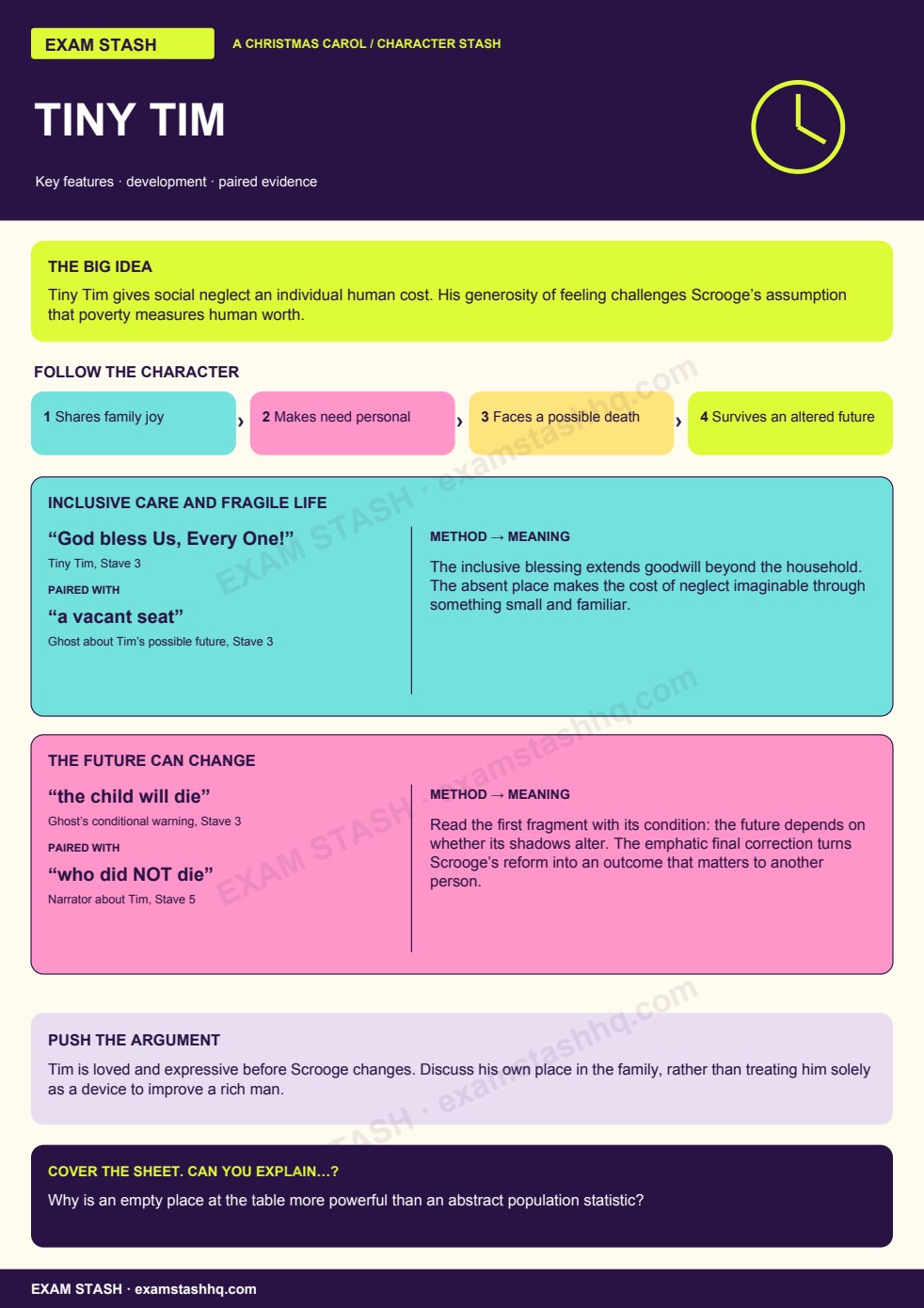
Tiny Tim gives social neglect an individual human cost. His generosity of feeling challenges Scrooge’s assumption that poverty measures human worth.
Read the accessible text and study notes
Tiny Tim
Tiny Tim gives social neglect an individual human cost. His generosity of feeling challenges Scrooge’s assumption that poverty measures human worth.
Shares family joy → Makes need personal → Faces a possible death → Survives an altered future
Inclusive care and fragile life
“God bless Us, Every One!” — Tiny Tim, Stave 3
paired with “a vacant seat” — Ghost about Tim’s possible future, Stave 3
The inclusive blessing extends goodwill beyond the household. The absent place makes the cost of neglect imaginable through something small and familiar.
The future can change
“the child will die” — Ghost’s conditional warning, Stave 3
paired with “who did NOT die” — Narrator about Tim, Stave 5
Read the first fragment with its condition: the future depends on whether its shadows alter. The emphatic final correction turns Scrooge’s reform into an outcome that matters to another person.
Push the argument
Tim is loved and expressive before Scrooge changes. Discuss his own place in the family, rather than treating him solely as a device to improve a rich man.
Recall
Why is an empty place at the table more powerful than an abstract population statistic?
Read A Christmas Carol. Scene locations are used because page numbers vary by edition.