AN INSPECTOR CALLS
Sheila Birling
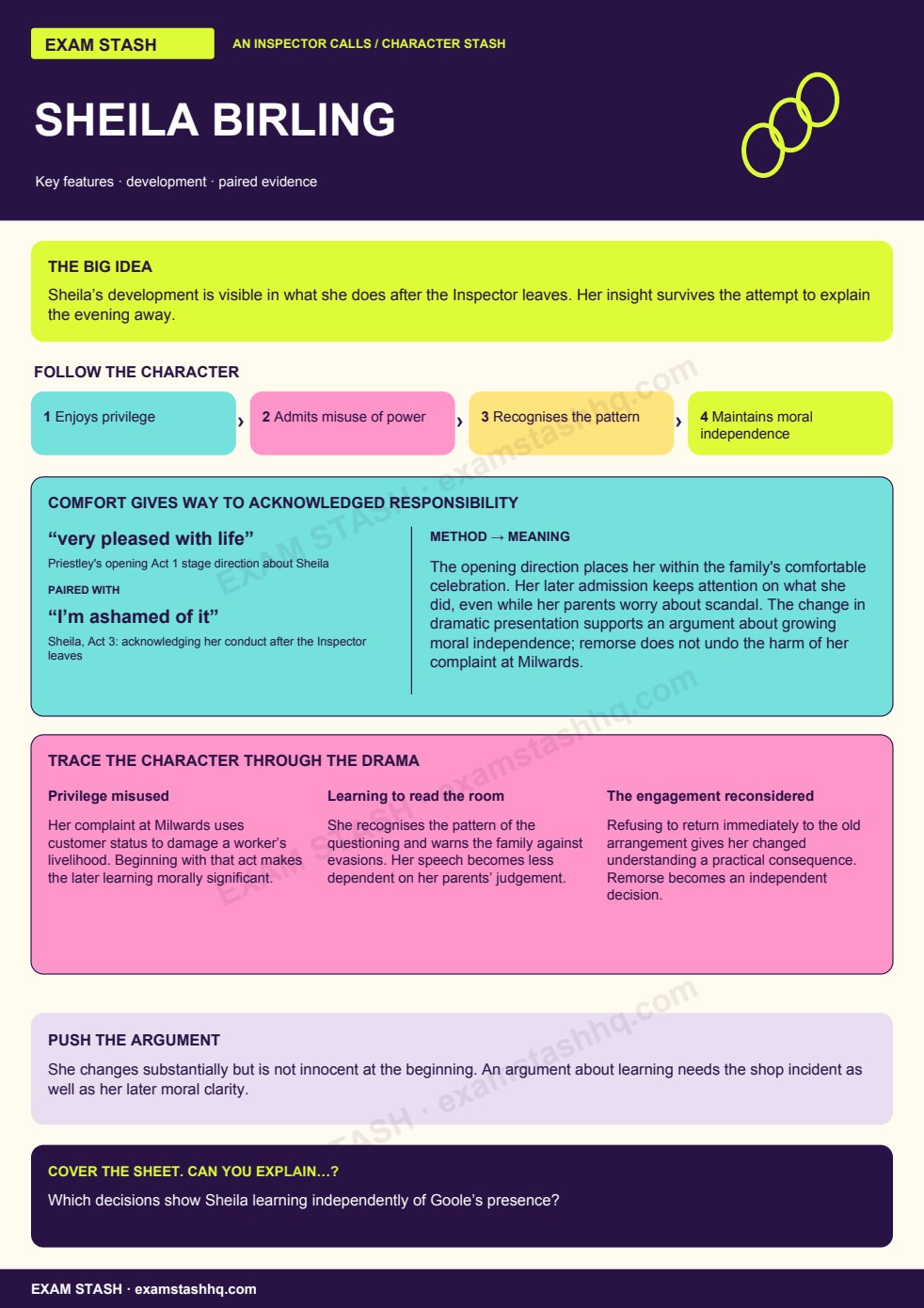
Sheila’s development is visible in what she does after the Inspector leaves. Her insight survives the attempt to explain the evening away.
Read the accessible text and study notes
Sheila Birling
Sheila’s development is visible in what she does after the Inspector leaves. Her insight survives the attempt to explain the evening away.
Enjoys privilege → Admits misuse of power → Recognises the pattern → Maintains moral independence
Comfort gives way to acknowledged responsibility
“very pleased with life” — Priestley's opening Act 1 stage direction about Sheila
paired with “I’m ashamed of it” — Sheila, Act 3: acknowledging her conduct after the Inspector leaves
The opening direction places her within the family's comfortable celebration. Her later admission keeps attention on what she did, even while her parents worry about scandal. The change in dramatic presentation supports an argument about growing moral independence; remorse does not undo the harm of her complaint at Milwards.
Push the argument
She changes substantially but is not innocent at the beginning. An argument about learning needs the shop incident as well as her later moral clarity.
Recall
Which decisions show Sheila learning independently of Goole’s presence?
Trace the drama
Privilege misused
Her complaint at Milwards uses customer status to damage a worker’s livelihood. Beginning with that act makes the later learning morally significant.
Learning to read the room
She recognises the pattern of the questioning and warns the family against evasions. Her speech becomes less dependent on her parents’ judgement.
The engagement reconsidered
Refusing to return immediately to the old arrangement gives her changed understanding a practical consequence. Remorse becomes an independent decision.
Evidence sources
- School quotation-recall sheet reproducing opening character stage directions. Its typography is simplified; quoted fragments selected avoid uncertain punctuation.
- Secondary complete script transcription; useful for exact Act/context checks but contains typographical errors. Wording cross-checked with school/board sources where available.
Explore the play. Scene locations are used because page numbers vary by edition.