BLOOD BROTHERS
Edward Lyons
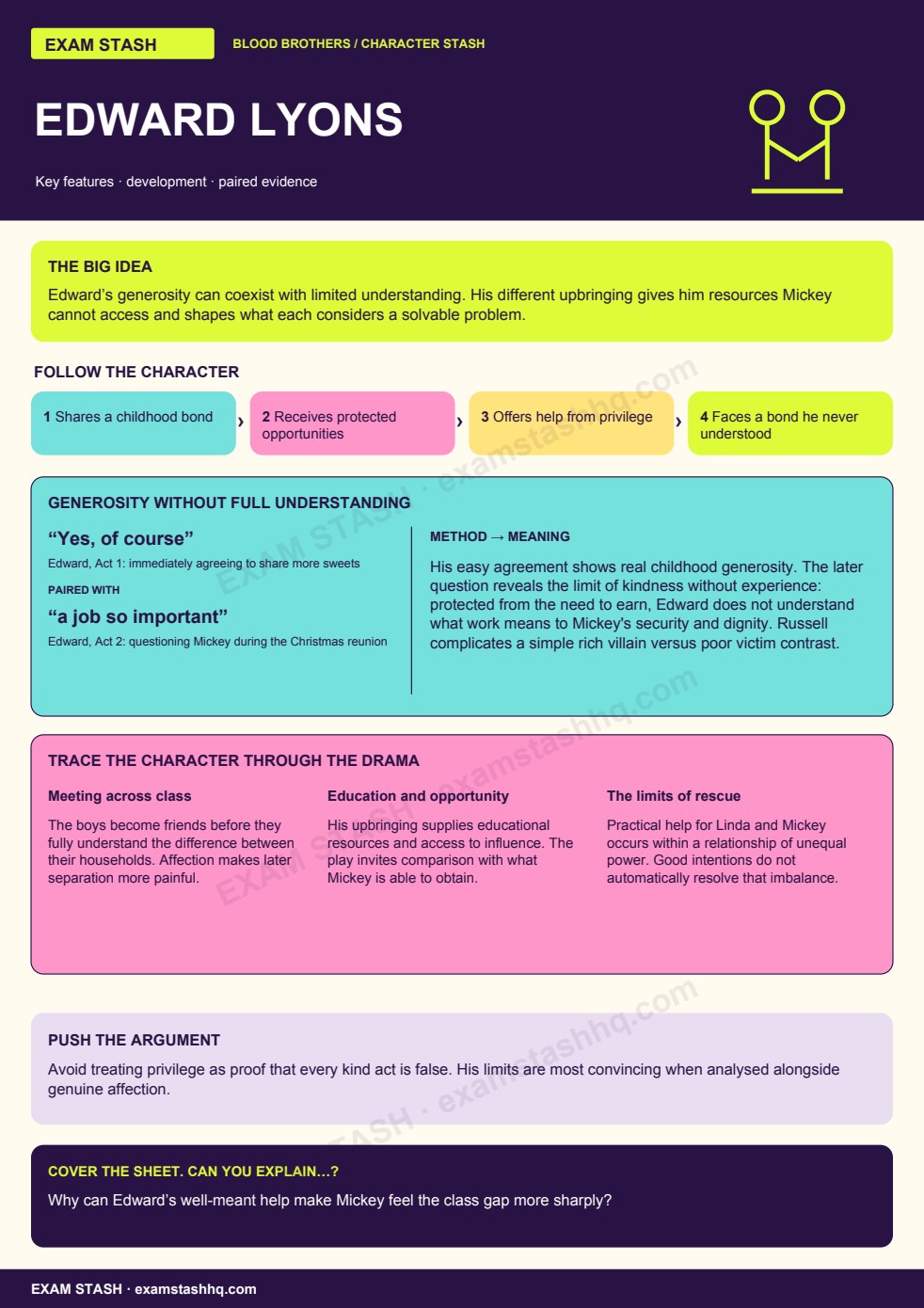
Edward’s generosity can coexist with limited understanding. His different upbringing gives him resources Mickey cannot access and shapes what each considers a solvable problem.
Read the accessible text and study notes
Edward Lyons
Edward’s generosity can coexist with limited understanding. His different upbringing gives him resources Mickey cannot access and shapes what each considers a solvable problem.
Shares a childhood bond → Receives protected opportunities → Offers help from privilege → Faces a bond he never understood
Generosity without full understanding
“Yes, of course” — Edward, Act 1: immediately agreeing to share more sweets
paired with “a job so important” — Edward, Act 2: questioning Mickey during the Christmas reunion
His easy agreement shows real childhood generosity. The later question reveals the limit of kindness without experience: protected from the need to earn, Edward does not understand what work means to Mickey's security and dignity. Russell complicates a simple rich villain versus poor victim contrast.
Push the argument
Avoid treating privilege as proof that every kind act is false. His limits are most convincing when analysed alongside genuine affection.
Recall
Why can Edward’s well-meant help make Mickey feel the class gap more sharply?
Trace the drama
Meeting across class
The boys become friends before they fully understand the difference between their households. Affection makes later separation more painful.
Education and opportunity
His upbringing supplies educational resources and access to influence. The play invites comparison with what Mickey is able to obtain.
The limits of rescue
Practical help for Linda and Mickey occurs within a relationship of unequal power. Good intentions do not automatically resolve that imbalance.
Evidence sources
Willy Russell: Blood Brothers. Scene locations are used because page numbers vary by edition.