A CHRISTMAS CAROL
Ebenezer Scrooge
Dickens makes redemption visible through changed relationships and practical care. Feeling differently matters because Scrooge begins to behave differently.
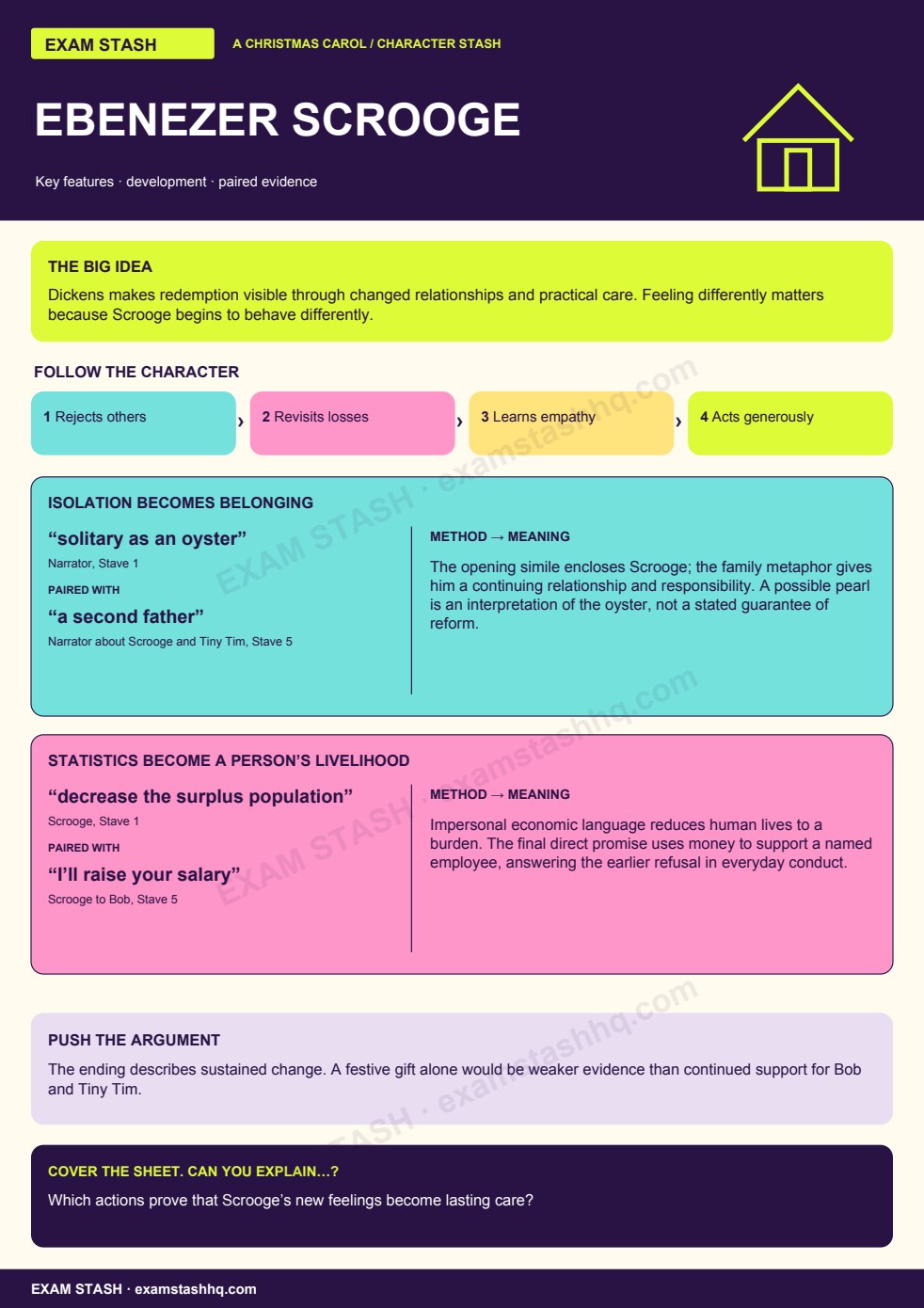
Read the accessible text and study notes
Ebenezer Scrooge
Dickens makes redemption visible through changed relationships and practical care. Feeling differently matters because Scrooge begins to behave differently.
Rejects others → Revisits losses → Learns empathy → Acts generously
Isolation becomes belonging
“solitary as an oyster” — Narrator, Stave 1
paired with “a second father” — Narrator about Scrooge and Tiny Tim, Stave 5
The opening simile encloses Scrooge; the family metaphor gives him a continuing relationship and responsibility. A possible pearl is an interpretation of the oyster, not a stated guarantee of reform.
Statistics become a person’s livelihood
“decrease the surplus population” — Scrooge, Stave 1
paired with “I’ll raise your salary” — Scrooge to Bob, Stave 5
Impersonal economic language reduces human lives to a burden. The final direct promise uses money to support a named employee, answering the earlier refusal in everyday conduct.
Push the argument
The ending describes sustained change. A festive gift alone would be weaker evidence than continued support for Bob and Tiny Tim.
Recall
Which actions prove that Scrooge’s new feelings become lasting care?
Read A Christmas Carol. Scene locations are used because page numbers vary by edition.